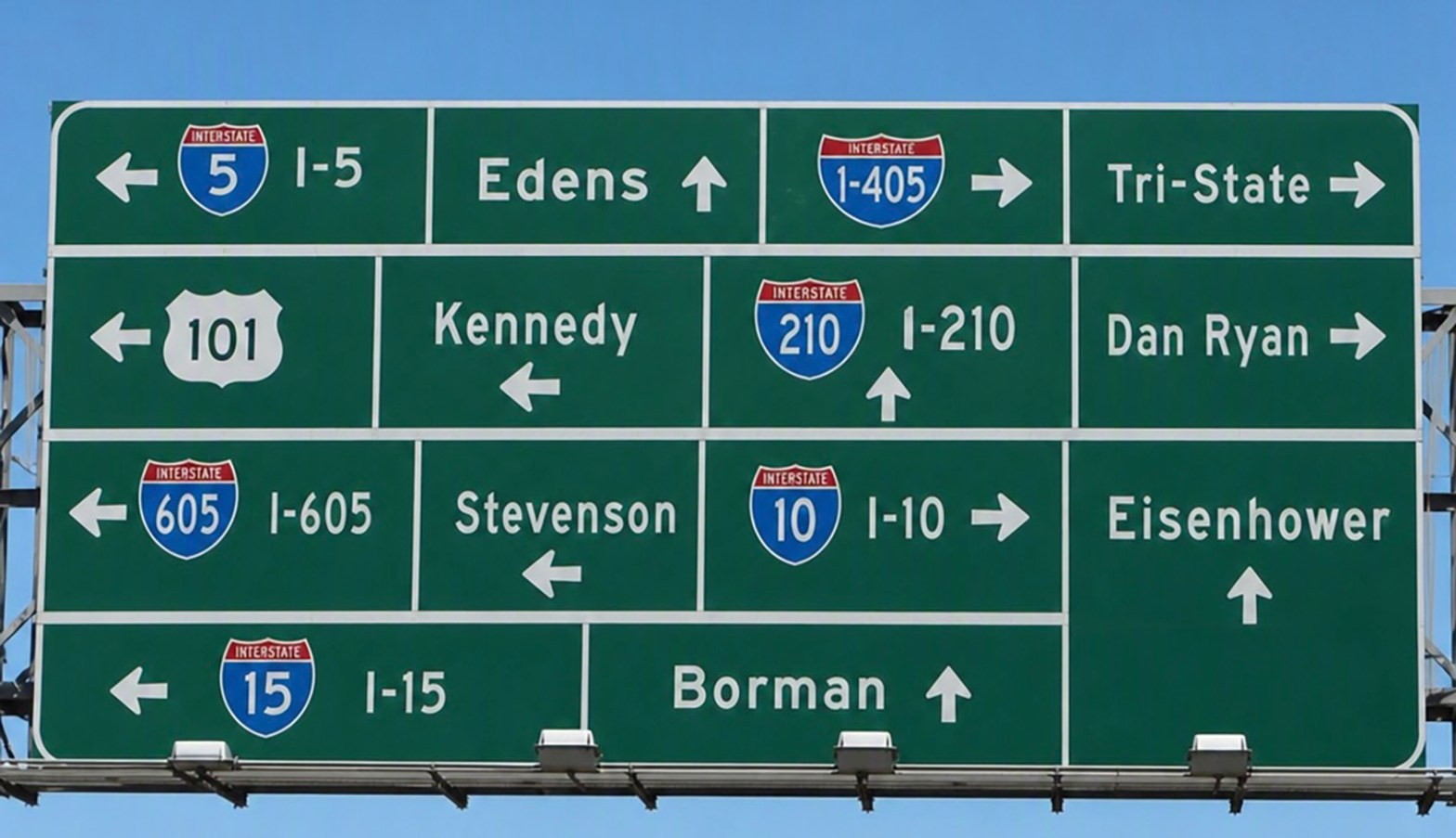
Over the past few weeks, I have driven quite a few miles and made a few observations while traveling on the highways and byways (that would make a great headline… make a note) of this fine country. I am going to share some of my thoughts from my time traversing this great country. I have to admit my travels were limited to SoCal and four Midwestern states: Illinois, Indiana, Michigan, and Wisconsin. Not really a national trip, but very different from my usual travels around SoCal… very different. There are no Cheese Castles or White Castles in the L.A. area. What a loss. I stand corrected; there is the Magic Castle in L.A., but do they serve sliders and cheese curds? Only if there is some sleight of hand.
Out here, the major highways are called Freeways. The name is derived from the fact that they were built to provide fast, free passage to where you wanted to go in Southern California…unless you include the tollways that have been added to the freeway system. They’re definitely not free. You have to be careful. One minute you may be heading to Orange County from the Inland Empire on a “freeway,” and the next, you are on a tollway. It is easy to get mixed up, and you may not know until you get a notice and fine for not paying your tolls.
I currently live in Southern California and have learned to give proper directions. All the freeways are referred to by their number designations. Example: In SoCal, you may go from the 5 to the 405, then the 101, down to the 10 or 60; that is, if you didn’t detour to the 15, 215, 210, or 605. Got it? I was never good at math. Yes, they all have names, but they’re never used. I think Saturday Night Live had a skit based on the subject, using overly exaggerated SoCal accents for the characters.
In the Midwest, the major thoroughfares are called expressways, and use proper names, numbers are not used. Imagine getting directions with an accent that sounds like something out of an SNL SuperFan skit (Da Bears). You can take the Edens to the Tri-State Tollway to the Kennedy (JFK). When you reach the Jane Byrne Circle interchange that will take you to the Dan Ryan, the Stevenson, or the Eisenhower (Better known as the Ike unless you are a staunch Democrat; then you will refer to this expressway by its original name, the Congress Expressway. Petty but true). Yeah, all the expressways have numbers, and some are the same, but where’s the fun in that
Freeways/Expressways were built to relieve congestion on the surface streets. Since they were built, congestion on surface streets still exists, and the Freeways/Expressways are also packed. In SoCal, to alleviate congestion on the Freeways, Caltrans, the geniuses who shoulder the blame for our freeway system, designed HOV (carpool) lanes. A quick note: my wife’s father was one of those people who engineered the freeway system. Don’t let her know I’m writing this.
The purpose of HOV lanes is to encourage carpooling and reduce congestion on overcrowded freeways. Excuse me, it will take me a moment to regain my composure after that line. I’ve never laughed so hard. The rules are that you may use the carpool lanes if there is more than one passenger in the car. Seems like a good idea, until you get to the exceptions, which seem to be any excuse. If your car is a plug-in hybrid or electric car, you get to use the HOV lanes, even if you’re the only one in the car. Motorcycles seem to be free to use the carpool lanes when they’re not zipping between cars at dangerously high speeds. I guess large trucks are also allowed to use these lanes, because I seem to always be stuck behind them in these “allegedly” reserved lanes. Don’t get me started on the charter buses. They’re usually filled with people heading to one of the many Native American casinos in our area. Besides all that, the roads still move at a crawl that a turtle would envy.
Much of the driving I did this summer was in the Midwest. I drove from Chicago, through Indiana to Michigan, took a ferry across Lake Michigan, then traveled in Wisconsin before heading back to Chicago.
The Midwest has five seasons: Fall, Winter, Spring, Summer, and construction season. Due to the harsh winters, the roads take quite a beating. The result is, as soon as the weather gets even a little bearable, a field of orange cones grows like tulips along all the roads in the spring. That is when road closures and construction signs appear to slow down anyone naive enough to think they might get somewhere in a hurry.
We drove through four states, and each had a different way of managing traffic in construction zones. In Illinois, road construction is everywhere. No breaks and orange cones as far as the GPS can see. Makes sense. There are millions of people in the Chicago area, and the roads get quite a workout. In Indiana, we travel on the Borman Express (also known as I-94, I-80, and, I think, I-65). The Borman is permanently under construction. Why, I have no idea. You drive for miles with one lane separated by orange barrels (not cones, as in Illinois), but you never see any construction. The barrels look old and like they have been in the same spot for years. I guess it saves time in taking them down and picking them up. I wouldn’t say that the state is pocketing federal funds and just appearing to do some work. No, I would never say that
In Michigan, they believe in giving drivers a proper warning that a construction zone is approaching. Miles before you get there, signs warn you of a lane closure, and when you get closer, you have multiple rumble strips that give additional warning. It doesn’t stop those idiots who try to zip by in the lane that is ending and trying to cut in at the last possible minute. Michigan roads are not too bad; drivers are horrible.
In Wisconsin, the construction zones are very neat and organized, but I do have a suggestion to make. Since they have the cones up, how about painting road strips a driver can see? In good weather, they are hard to see, but when it is raining, it is impossible. Nothing like driving in traffic with a bunch of big trucks and nobody knows which lane they are supposed to be in.
Now that I’m done describing the roads we drive on, I will now share some of the things I have seen while on our highways
The Midwest roads have a different collection of “shoulder trash” than in SoCal. What we saw the most were dead animals, better known as roadkill. They must do a great job of removing trash because we saw very little of it. Animals were another thing. It surprises me that raccoons still roam the forest, given the number of dead ones we saw on the side of the road. Maybe it was a mass suicide because they know winter’s coming.
There were also quite a few dead deer on the side of the road. These are not small animals, and I can only imagine the damage they caused to the cars they hit. I have friends who have totaled their car by hitting a deer, and the deer got up and left.
While we were in Michigan, we had to avoid a few deer that jumped into the road in front of us. They are big, beautiful, and very dangerous. We also did see some possums, but you never know if they’re dead or just faking it. Maybe it was an insurance scam. Can’t trust an opossum.
In Southern California, you find a different kind of road trash. One could furnish a house or build a car from what you find on the freeway’s shoulder. If you’re in need of a mattress, just hop on the 405, and I’m sure you’ll come across one in a few miles. How about a new bumper for your car? A perfectly good wheel with a tire may go rolling by you at any time. I’ve seen chairs, desks, and even briefcases. Sometimes you may see some roadkill, but it is usually the body of someone who jumped off an overpass. Probably because they were frustrated with driving the freeway system out here.
I know that some of you will say that I have been dealing in innuendo, stereotypes, and fantasy, and I say to that…pretty much. It may be a bit of an exaggeration, but it is based in fact, and it made writing this easier than doing research. I’m a commentator, not a journalist. I save the journalism for the articles that pay. Safe travels (I also deal in fantasy.)
©2026BBRiley.com

